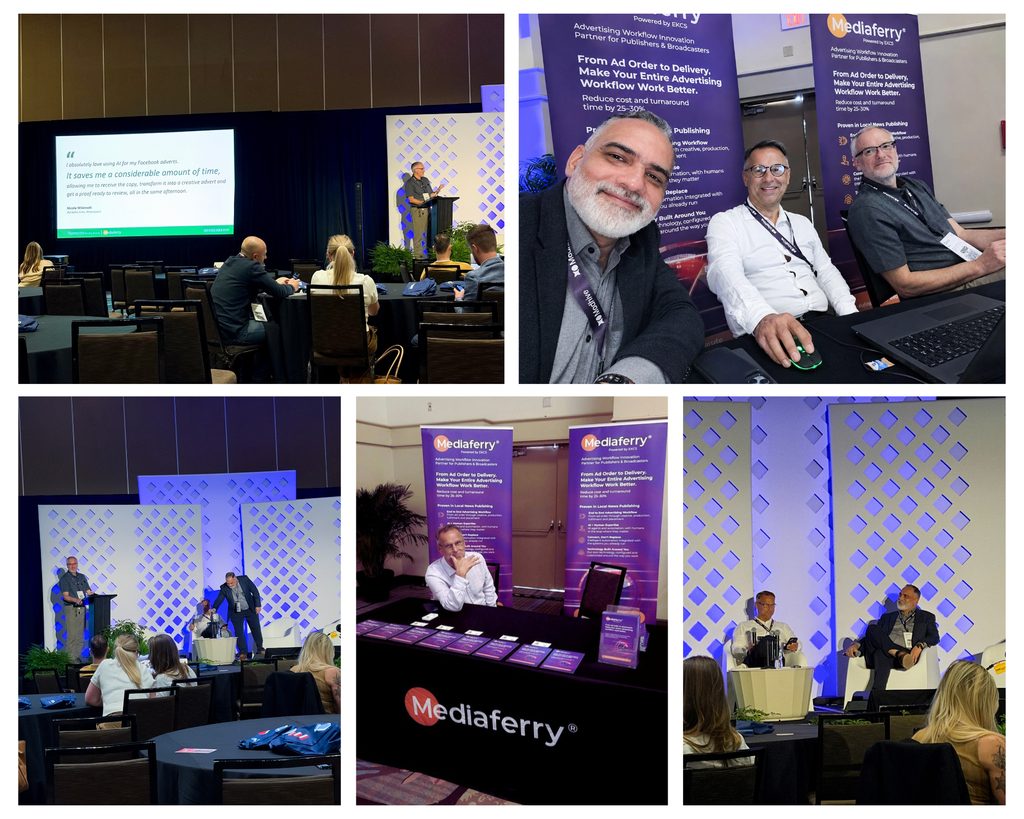
At Lead to Cash Bash, David Yeo of Newsquest sat down with the Mediaferry team to walk publishers through one of the most successful AI rollouts in the industry and to explain why the numbers were the smallest part of the story.
David opened the session, drawing attention to the transition he went through since he entered the publishing industry 36 years ago. From wax and scalpel to AI, he told the room.
Newsquest, where he is an Operations Manager today, is one of the UK’s biggest local news groups, part of USA Today, with 250 news brands, 50 million monthly web visitors and 4 million weekly print readers. Any production efficiency ripples across that scale quickly.
The business problem that started it
Creative production was holding up the sales team. A typical digital ad took 10 hours to produce. A salesperson who closed a strong meeting in the morning often waited until the next day before they could show the advertiser what their campaign could look like. The sales window cooled while the queue moved.
Newsquest’s goal wasn’t just implementing AI for the sake of it. It was a faster turnaround alongside better customer service, protected quality and lower production costs, delivered across teams, regions and brands.
Newsquest chose Mediaferry because of an existing relationship, a clear product roadmap and a shared willingness to build the right version together.
“We never expected the first version to be right,” David said. “We wanted to shape it as we went.”
How Smart Design AI fits inside Newsquest’s workflow
Smart Design AI is embedded directly into Naviga, Newsquest’s order and workflow system. A sales rep raises a creative request the same way they always have. Business rules route simpler, templated work to AI and more complex work to designers. A brand memory feature keeps each ad consistent with the advertiser’s brand across repeat jobs.
If a rep isn’t happy with the AI version, there’s a one-click escalation path to a designer. A Mediaferry dashboard tracks every salesperson’s AI usage, quality score and rejection rate, which Newsquest uses to challenge outliers and feed valid feedback back to Mediaferry.
The results
- Creative turnaround cut from 10 hours to 10 minutes
- 31% reduction in digital production costs
- More than 80% of eligible digital ads now produced through AI
- Around 1,700 digital campaigns a month running through the system
- A sales-team quality score of 70% today, nudging towards the agreed 80% KPI as Design Match comes online
Connor, a sales executive at Newsquest, described the tool as making him more efficient and improving customer service. Nicola, a salesperson, could receive a copy, get Facebook creative produced and have a proof ready within a single afternoon.
Where the rollout succeeded
Kevin Shelcott from Mediaferry asked David what actually drove adoption. David credited three things.
- First, the Naviga integration so the salespeople had nothing new to learn.
- Second, a phased crawl-walk-run rollout that started with a small pilot on live campaigns, refined templates on real feedback, and moved to mandatory AI for simpler ad types only once confidence was built.
- Third, a designer is always in the loop, so no one hits a dead end.
“The system seemed too good to be true,” one Newsquest training manager said. “But it is actually that good.”
What’s next
Newsquest’s success so far has been in digital. Print is next. The complexity around layout and image resolution means designer oversight stays central, and Mediaferry is working on resolution upscaling for website-scraped images.
Puneet Lamba noted that Mediaferry can output InDesign packages for print and fully editable HTML content in the browser.
David’s closing message to the room was the one that kept coming back in the hallways afterwards: start with the business problem, not the technology.