As we explored in ‘Print advertising is not dead‘ , demand remains strong. The constraint for most publishers is not the market; it is operational speed. Operational modernization is the only way to convert that demand into revenue and protect margins from rising production costs without being slowed down by legacy constraints.
The operational bottleneck
While larger media groups lean on a massive scale, local publishers face a dilemma. Print remains a vital pillar of brand authority, but the cost of complexity is rising. Newsprint costs have jumped and now sit between $580 and $670 per metric ton. Profitability hinges on efficiency.
The true threat isn’t a lack of demand; it is the operational bottleneck created by:
- Manual touches: Legacy workflows need too many hands-on steps to move an ad from sale to press.
- Production friction: Teams spend more time fixing low-res files or color profiles than they do building client relationships.
- Complexity costs: High production overhead often prices out the very local advertisers who want to be in print.
To win again, local news doesn’t need only more ads; it needs a cost-effective way to manage them.
Sample savings
A manual workflow costs an average of $78 per ad in labor; an automated one drops that cost to circa $11.25.
| Monthly Ad Volume | Monthly Manual Cost ($78) | Monthly Automated Cost ($11.25) | Monthly Savings |
| 50 Ads | $3,900 | $562 | $3,338 |
| 100 Ads | $7,800 | $1,125 | $6,675 |
| 250 Ads | $19,500 | $2,812 | $16,688 |
| 500 Ads | $39,000 | $5,625 | $33,375 |
With 250 ads per month, automation protects over $200,000 in margin per year.
*These calculations are based on a burdened industry labor rate of $45/hr. Manual costs assume 1.75 hours of total human touch (sales, booking, design, and multi-round revisions). Automated costs assume 15 minutes of total oversight, using AI to handle creative generation and technical delivery.
From friction to flow
To capitalize on the US newspaper market, projected to reach $20.3 billion by 2033, publishers must reduce workflow friction. Automating print ad production transforms the operation from a series of manual tasks into a “force multiplier” for your team:
Lowering the cost per ad
By removing the back-and-forth of emails and manual sizing, you lower overheads. This enables you to offer more competitive packages to local advertisers, bringing them back into the fold and boosting revenue.
Improving print ad turnaround time without adding headcount
Modern, cloud-based systems centralize production. A lean team can handle the volume of a much larger department by using real-time status tracking and standardized templates that prevent technical errors.
Speed as a unique advantage
Efficiency enables local media to match the operational speed of digital giants while maintaining their unique advantage: community trust and personal relationships.
Moving away from fragmented systems saves time and protects margins so local news can afford to evolve.
Is your operation ready for modernization?
Is your publisher ad workflow automation capping growth? Use this checklist to find out:
- The 48-hour wall: Ads take 24 to 48 hours (or more) from order to proof.
- No ad mock-ups: Sales cannot show a mock-up during a pitch, which slows the sales cycle and delays revenue.
- The email abyss: Approvals happen over email; files get lost; versions conflict.
- The creative drain: Designers spend hours on repetitive resizing, formatting, and spec work rather than on high-value campaigns.
News publisher creative automation removes friction and protects margins. If you checked more than two boxes, your current publisher ad workflow automation is likely the bottleneck.
AI + integration: Moving to a repeatable system
Publishers need to shift from ‘create every ad’ to ‘operate a repeatable system’. This means:
- Standardized inputs (brief/data capture)
- Template-driven AI production
- Automated checks/preflight
- Structured approvals
- Connected delivery and reporting loops
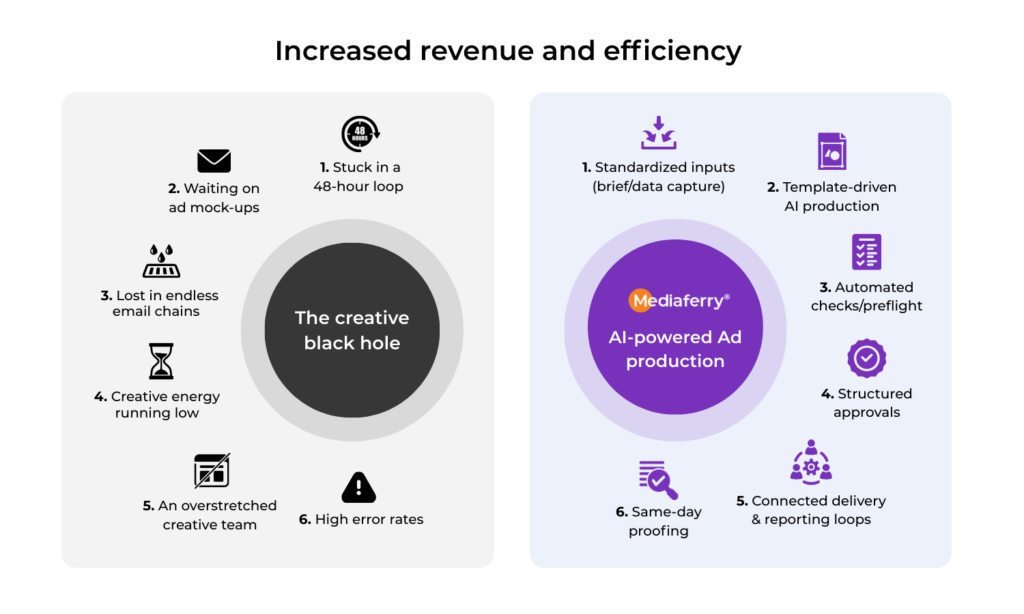
Leading print operations are saving production time by shifting from ‘creating every ad’ to using a repeatable system. Publishers using automated template systems have reduced turnaround from 48 hours to same-day proofing.
The real-time savings come from integration. When booking systems, templates, approvals, and prepress workflows are connected, handoffs disappear. Fewer handoffs mean fewer errors, fewer revisions, and massive time savings per campaign.
Faster production creates sales momentum
One byproduct of automating print ad production is speed during the pitch itself. When sales teams can generate a branded mockup in seconds, conversations shift from abstract pricing to tangible ideas. Sales teams become less dependent on studio queues; they can produce spec ads quickly, which increases close rates.
Instead of waiting days for creative, reps present ad samples and concepts instantly, accelerating approvals and improving sales performances. Speed in production becomes speed in revenue.
Automating print ad production
Automation is a must. So what’s next? Start with rules before you scale with AI. Structured workflows ensure AI adds value rather than accelerating errors. Standardized briefs, mandatory fields, template logic, and approval routing create consistency. Once the process is predictable, AI can enhance it.
To move from a manual bottleneck to high-velocity output, focus on:
- Rules-based automation (removing manual steps, enforcing consistency) before advanced AI/optimization.
- Brief intake standardization (mandatory fields, brand guardrails).
- Template library + variations (sizes, localizations, offers).
- Automated proofing and approvals routing (with clear owners and service level agreements (SLAs)).
- Automated delivery handoff to publishing/print workflow.
- Closed-loop learning (what versions/placements perform; feedback into templates)
Your 90-day modernization roadmap
You don’t have to change everything overnight. Follow this phased approach and improve your print ad turnaround time:
| Phase | Focus | Actions | Outcomes |
| Days 0–30 | Diagnose & establish baselines | Map your workflow. Pick one high-volume category (like real estate, obits, classifieds, or retail) to test. Establish baseline metrics: turnaround time, touches per ad, and revision count. | Clarity on where the margin is leaking. |
| Days 31–60 | Build repeatability | Create your template library. Define brand rules. Set approval paths. Train sales teams and ad ops on create → review → approve workflows. | The first automated ad category is live. |
| Days 61–90 | Scale & integrate | Expand to more ad categories or titles. Connect your booking, CRM, and ad systems to stop double-entry errors. | Measurable reduction in turnaround and cost per ad. |
Overcoming the “buts”
When it comes to sales teams and processes, it is natural to experience pushback and resistance to change. You might hear:
“Won’t all ads look the same?”
No. Automation handles the structure; your designers provide the soul and brand guardrails.
“Sales won’t adapt to new tech.“
They will when they realize they can close deals faster with instant mockups in their hands.
“Designers will object.”
Many designers find that automation removes repetitive production work. Automation and AI can enable in-house designers to focus on higher-value advertising creative and campaign strategy.
What does success look like?
To know if your automation is working, measure these six metrics:
- Campaign turnaround time: How much faster is the ad produced?
- Time to sell: How much sooner can you close a deal?
- Close rates: Is your sales team winning more deals because deals are faster?
- Time saved: How much quicker can ads go live?
- Advertiser satisfaction: Are your local businesses happier with the seamless process?
- Cost per ad: Has your overhead per page decreased as manual touches are removed?
Empower your sales team to close faster – Find out more about Mediaferry.
See how revenue teams generate branded mockups in seconds and remove studio bottlenecks from the sales cycle. Book a revenue-focused demo.