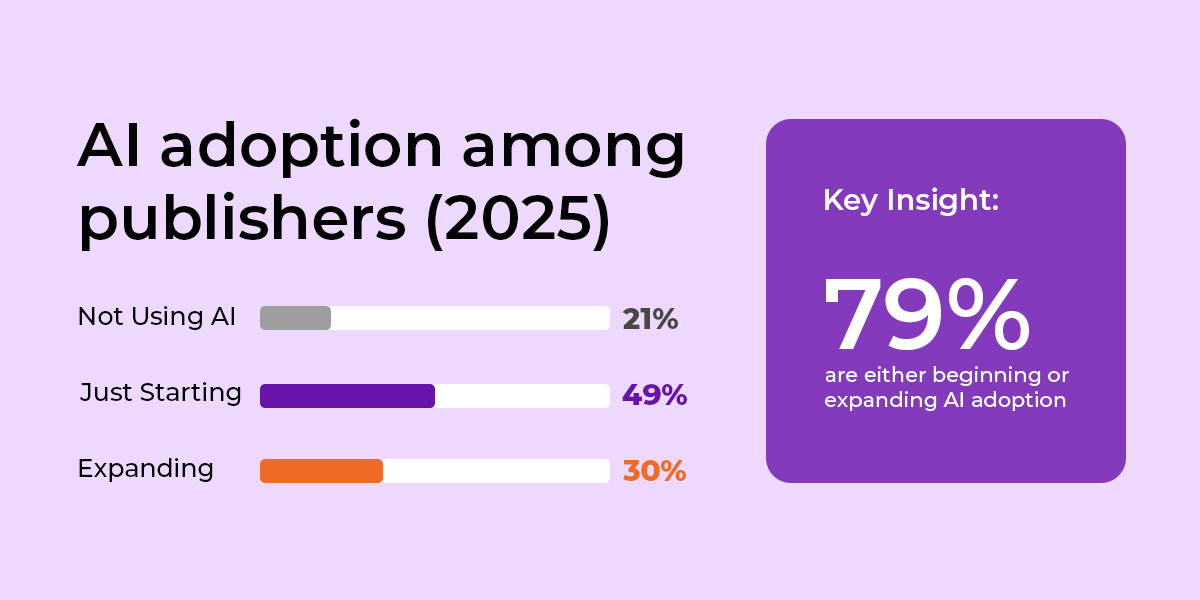
AI is no longer a fancy plaything for the big publishers. Even small and regional publishers are using AI to some extent in their workflow. According to a 2025 WAN-IFRA survey, a combined 79% of publishers are either beginning or expanding their use of AI, with 49% just starting and 30% increasing their adoption.
With the increasing use of AI in publishers’ workflow for ad production, the question remains – is it safe and will it risk brand reputation or control?
In this blog, we’re going to explore practical steps on how to use AI safely in your AdOps workflow.
Safety lies in starting small yet smart
Many brands have faced reputational risks from AI-generated assets: think Disney and Universal suing Midjourney over unauthorized character ads. The issue isn’t AI itself, but deploying AI without guardrails.
Instead of an all-in AI overhaul, small publishers should pilot one high-leverage workflow with clear metrics for performance and compliance. Here’s a simple criteria.
Select workflows that meet these criteria:
- High manual effort: Ad assets in multiple sizes/languages take studios ~48 hours (including queues).
- Direct revenue impact: Live ad proofs during sales calls close deals faster no studio delays.
- Low editorial risk: Focus on ads/proof-of-performance; avoid core journalism.
Safest starting points:
From working with news publishers of all sizes, we’ve observed they prioritize AI in these domains, low-risk, high-revenue-impact areas that save significant manual effort:
- Spec/live ad proofs for sales: Generate compliant assets in minutes during pitches.
- Basic proof-of-performance reporting: Automate tear sheets and ROI visibility.
Design an AI pilot for single workflow
Most AI rollout programs don’t fail because they were wrong, but because they are too ‘ambitious’. That’s why at Mediaferry, we suggest starting small with hyper-precision. The right and ‘safest’ way to do this is to design a tightly-scoped AI pilot program for your ad production workflow that delivers measurable and logical results within weeks, not quarters.
- Ringfence your pilot to 2-3 markets, 4-5 salespeople and a single ad format – Print spec ads plus digital leaderboards is a strong starting combination because it covers both legacy and digital formats without overwhelming the team. Give the pilot four to six weeks. That’s enough time to generate meaningful data while keeping the commitment low enough that leadership doesn’t need a board-level sign-off to say yes.
- Introduce human guardrails – AI automation never means human oversight. Human in the loop is what separates a risky adventure to a careful experiment. First, maintain a human-in-the-loop at every stage. No AI-generated asset should go live without human approval. This means building a clear approval path – the sales person checks the final output, AdOps reviews the compliance and branding, and the studio sign-offs on creative quality.
- Spend time building your brand guideline on AI platform – Spend more time sharpening your axe than cutting the log. A well-defined brand guideline creates guardrails that keep every asset on track, no matter who generates it. That means ad sizes, fonts, colour palettes, bleed specifications, CMYK profiles, and ad server specs are all predetermined and enforced by the platform.
- Establish clear data boundaries for your AI platform – Clearly define what data enters the AI ad production platform and what shouldn’t ever be fed to the AI systems. Commercially sensitive data and IP carry both legal and reputational weight. None of these should be fed to the AI platform. To ensure this, news publishers must ask their AI vendors these three questions before the pilot goes live: Does the platform use submitted data to train or improve its models? Where is data stored, and does it leave your jurisdiction? What is the data retention policy and deletion mechanism? To ensure data security, assign a data steward for the pilot program who is accountable for ensuring that the boundaries are respected every time, flagging any vendor’s changes in terms of service.
Your 6-week AI pilot framework
Scope: 2-3 markets, 4-5 salespeople, 1 format
| Week 1-2 (Setup) | Week 3-4 (Run Pilot) | Week 5-6 (Measure) |
| Define scope | Monitor KPIs | Review data |
| Build guides | Gather feedback | Decide next steps |
| Train team | Document issues | Scale or iterate |
| Collect metrics |
Define metrics right from the start
Track your AI pilot for measurable KPIs and define what number defines its success for your business. Metrics to define up front can be as follows:
- Ad turnaround time – Based on our data, publishers using AI-assisted ad production have reduced turnaround time by up to 90% compared to traditional studio workflows. Establish your current baseline before the pilot begins, then track weekly. This single number will do more to build internal confidence in AI adoption than any vendor case study.
- Percentage of ads produced without studio involvement – Set a target for what proportion of your total ad volume you intend to route through AI production during the pilot period. This is not about replacing your studio; it is about understanding which formats and use cases are genuinely suited to automation, and at what scale. A 30–40% target is a reasonable starting point for most regional publishers, with room to adjust as the data comes in.
- Demo-to-close rate and renewal uplift – When a salesperson can present a live, brand-compliant ad proof during the pitch itself, the conversation shifts from “we’ll get back to you” to “when can we start.” Track close rates and renewal rates separately for accounts managed within the pilot cohort versus those outside it. This comparison gives you clean, credible evidence of commercial impact, the kind that earns leadership buy-in for a full rollout.
Put structure around AI
Ungoverned AI produces ungoverned output. The single most effective thing a publisher can do before scaling AI ad production is to establish structure — not after problems emerge, but as the foundation the entire workflow is built on.
Begin by building brand memory for each advertiser. Ingest their website, existing creative assets, and brand guidelines directly into the platform. Where a formal brand guide does not exist (common among smaller advertisers), publishers can construct one using a structured brand memory framework built into the platform, then refine it through human review before it is ever applied to live production. This step alone eliminates a significant proportion of revision cycles.
Next, lock your templates. Print, digital, and video formats should have pre-configured specifications covering dimensions, bleed, colour profiles, font stacks, and file output requirements. These should not be adjustable ad hoc. When templates are locked, compliance becomes the default, not the exception.
Finally, embed your approval pathway into the platform itself. A process that lives in a shared document or an email thread will not survive a high-volume period. When the review and sign-off steps are built into the workflow, salesperson checks creative accuracy, AdOps validates compliance, studio confirms quality, the process holds regardless of how much pressure the team is under.
What about copyright?
Copyright is one of the most frequently raised concerns we hear from publishers exploring AI-assisted ad production, and rightly so. A growing number of AI-generated assets have placed brands in legally ambiguous territory (source), with liability that can travel up the chain to the publisher who facilitated the campaign.
To ensure your advertisers are protected, start with a direct question to your AI vendor: where do the image assets come from? The only defensible answer is that the platform draws exclusively from advertiser-owned sources — their website, uploaded brand assets, and approved social media content. If third-party image libraries are involved, verify that every asset carries a commercial licence that explicitly covers AI-assisted use. Generic stock licences often do not.
Beyond vendor assurances, build your own layer of accountability. Designate a brand guardian, someone within your AdOps function whose role includes verifying that every asset used in a campaign can be traced back to a source the advertiser owns or has licensed. This is not a bureaucratic checkpoint, it is a professional standard that protects your publication, your advertiser, and the integrity of the campaign.
Start small. Stay in control. Scale with confidence.
The publishers who will lead the next decade are not the ones who adopted AI fastest, but the ones who did it more safely and intentionally. Every step outlined in this guide is designed to give you meaningful momentum without exposing your brand, your advertisers, or your readers to unnecessary risk.
The pilot does not have to be perfect. It has to be purposeful, carefully managed and measurable.
If you are a small or regional publisher wondering whether AI-powered ad production is even within reach, the answer is yes, and the starting point is closer than you think. Read how small publishers are already thinking big with AI to automate ad production and streamline their workflows.
Ready to design your pilot? Talk to the Mediaferry team.